

In collaboration with Galerie Kandlhofer – Film, edit and text by Alex Schuchmann
What are we „Orphaned“ of? Are we living a life that is true to our real nature or are we living in the desert of our existence? Our new film explores the theme of alienation from the natural world and follows the French painter Theo Viardin and the development of his recent body of work, which I first encountered during a visit in Marseille. What started there later continued in Vienna, where we were invited by Galerie Kandlhofer to document the installation and opening of the show with the same title „Orphaned“.

It was early November and I just left my home in Portugal to go on the road again. “The first official Hometown Journal South West Europe Tour,” I said jokingly a couple of times to myself while driving highly caffeinated from Porto towards the north of Italy. On that trip I would meet Vinicius Lopes and Manon Blet, whose films are already published, but also Theo Viardin, originally from Paris but today based in the Mediterranean metropolis Marseille. When I spoke to Theo on the phone a few weeks prior I became very curious about his current body of work as he shared with me that he was creating “sacred paintings.” Being a pseudo-anthropologist and philosopher myself I decided to stay for a few days with Theo and document his current practice.
I arrived in Marseille on a rainy day, the streets narrow and congested with cars. I met Theo in the evening at his studio and it was pouring, so we decided to drive to his home instead of walking. And that became a somewhat fatal decision, as the drive turned into almost two hours, including searching for parking next to Theo’s apartment. To keep costs low, I even ended up sleeping in the painter’s own bed (which will definitely become a cute anecdote I can share when Theo becomes a celebrity painter). Theo spent the nights with his partner Thelma.
After a good night’s sleep, Theo and I set off to the studio. This time we walked, which gave us a good opportunity to get to know the artist behind the paintings I only knew from Instagram, works that apparently allowed him to live off his practice for the last five years while also forcing him to work intensely every day. Having studied graphic design and worked self-employed in his own studio with a friend, he quickly became frustrated with motion design software and started painting in his own room. A painter friend soon told him to work on larger canvases and guided him through those first steps until Theo began reaching out to galleries and trying his luck. After initial rejection, he landed his first solo show. While walking, Marseille passed by us in fragments, the Mediterranean autumn air juxtaposed with the noise of a vibrant city just waking up.


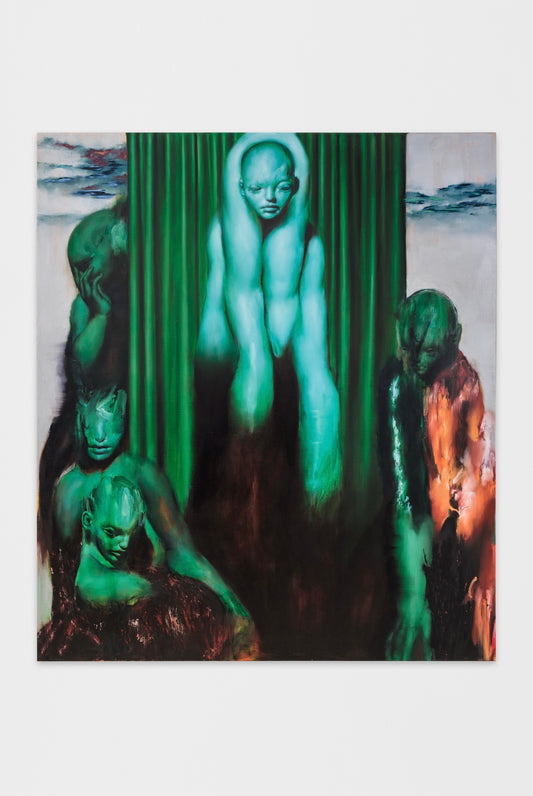
Once at the studio, Theo showed me his current body of work, which he was preparing for a show in Vienna in April 2026. It was those “sacred” paintings he had spoken about on the phone, and I was mesmerised by the shapes that felt both human and alien at the same time. After a coffee (Theo loves coffee), we started working. He mixed paint, and I set up the tripod at a comfortable height. On today’s schedule was a painting that would soon be titled Sacred Study, green (and even turned into the edition you can find below). I watched how Theo seamlessly blended paint into an already existing fabric of colour and texture, and he shared how important composition and speed are for him. If something felt out of balance, he would not stop until it was corrected. For him, a balanced painting reflects a balance within our own systems, both in the body and collectively—if one force dominates another, something collapses, like a struggle within cells.
Theo does not work from memory or imagination but predominantly with pre-created imagery, based on drawings he reworks, imports into Photoshop and develops digitally until satisfied. This process evolved after realising that going straight onto the canvas often left him disappointed, while working only digitally felt “stupid.” So now he composes mostly in Photoshop but leaves space for experimentation and chance on the canvas itself. Sometimes it flows effortlessly, especially when he reaches the flow state he speaks highly of, because for Theo, in that state of creation, lies a forgotten treasure of human existence. “Creation itself is sacred. Being in flow is sacred,” the painter tells me repeatedly throughout the day.
In another painting that would become Post Apocalypse II, I could watch Theo apply the second layer. What looked like liquid fire in the first layer was slowly covered by silhouettes of red figures. Each layer takes time and focus, as for Theo, every stage could potentially be the final painting. He would even want each layer to exist as its own artwork. Within each layer, he also learns something about what the painting wants to become, until he is ready for the final one. There is no recipe, only trying, waiting, and the moment when joy appears, and the image reveals itself. The creation of human figures feels to him like the creation of life itself, a statement I found deeply beautiful. We ended the day with dinner with one of his studio mates, and the next morning I was back on the road towards Turin. Business as usual.
Get one out of 12 signed editions:
-
Sacred Study, Green (2026) - Théo Viardin
Regular price From 420€Regular priceUnit price per -
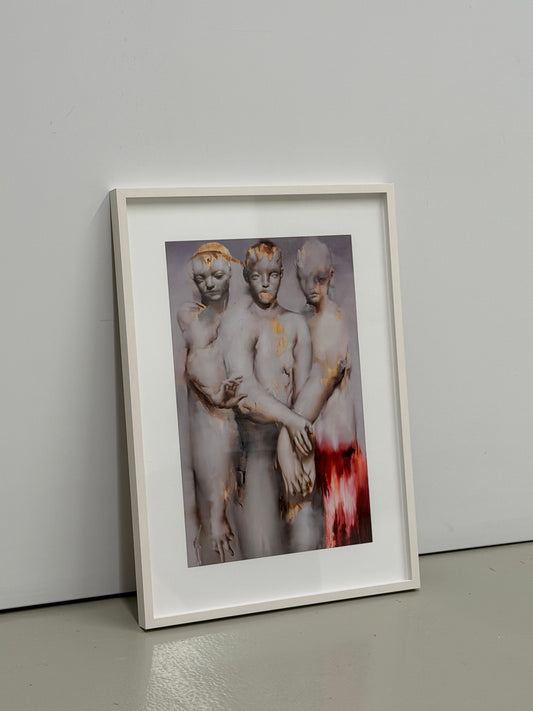
Grief (2026) - Théo Viardin
Regular price From 420€Regular priceUnit price per


Months passed, and one day, while I was editing the film and shared a still with Theo, he wrote to me that it might be better to hold off, as a gallery in Vienna could be interested in collaborating with us: Galerie Kandlhofer. They indeed invited us to the installation of Theo’s new body of work as well as to the opening of the show. So earlier this month, I took a flight from Milan to Vienna to finish filming Theo, who by then already felt like a friend. I learned that the show was called „orphaned“ and speaks on the alienation of the original motivation of Theo to create paintings that feel somewhat distant to the rich heritage of painting that we are left with. What else happened there and what we spoke about I don’t want to share here, but instead invite you to watch our new 25-minute documentary that follows Theo’s process from creation to installation and final reflection.
With gratitude and humility we want to thank Galerie Kandlhofer for this opportunity, which marks our first collaboration with a gallery.
More stories
View all-

"Such was my instinct. Licking off his tear. "
An untitled text by Lara Konrad, author of the forthcoming novel Insufferable, about a tongue, slowness and touch, and tasting the world without shame.
"Such was my instinct. Licking off his tear. "
An untitled text by Lara Konrad, author of the forthcoming novel Insufferable, about a tongue, slowness and touch, and tasting the world without shame.
-

A day in the studio with Sofía Serpa Arango
On a chilly December afternoon in South London, painter Sofía Serpa Arango let us into her studio and into a world built from Colombian costumbrismo, Austrian folklore, and cowboy myth.
A day in the studio with Sofía Serpa Arango
On a chilly December afternoon in South London, painter Sofía Serpa Arango let us into her studio and into a world built from Colombian costumbrismo, Austrian folklore, and cowboy myth.
-

Days in the studio with Irena Posner
Two days in Carrara, Italy with a sculptor who carves stone into dogs, cats, feet, and something that feels like reflections of ourselves.
Days in the studio with Irena Posner
Two days in Carrara, Italy with a sculptor who carves stone into dogs, cats, feet, and something that feels like reflections of ourselves.


